
The period of 2025-2030 is forecasted to be a strong starting point for dual transformation in Vietnam, in which chain systems have a profound impact on all aspects of life through the strong development of a new resource called DUCA.
The resource is generated from the user community data management system using artificial intelligence. In the next decade, governance models will transform more strongly with the support of artificial intelligence to serve the process of planning human behavior for a sustainable Vietnam, rising strongly in the new era.
On the eve of the Lunar New Year, a reporter from the Environmental Economics Magazine interviewed Dr. Bui Thi Thanh Huong – Deputy Head of the Executive Board of the Hanoi National University Scientists Club, Founder of VNU Greentech Spin off, environmental education expert of Hanoi National University about new shifting trends in the dual transformation period of Vietnam.
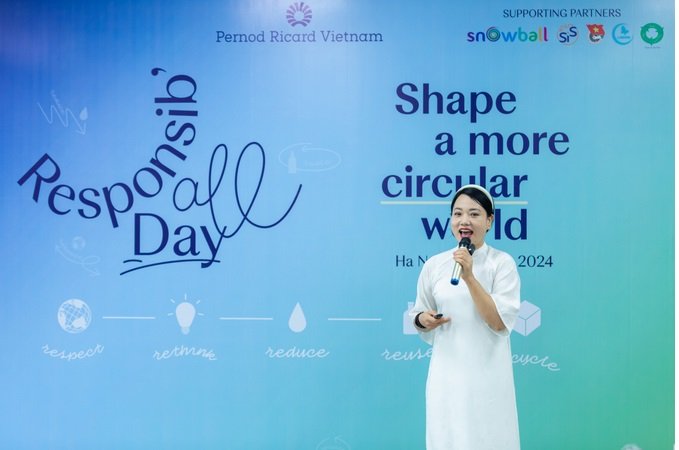
Dr. Bui Thi Thanh Huong.
* Madam, as an environmental education expert, what should be the priority for Vietnam’s dual transformation period in the year of At Ty?
– In my opinion, Vietnam needs to prioritize “Green Behavior Planning” at all levels, from the smallest organizational unit to the highest organizational level of the country. In which, the “quantity” and “quality” indicators of green behavior of each organizational unit need to be selected as criteria for competitiveness at all levels. And green behavior planning needs to be based on a big data resource called DUCA (Data + Users + Communities + AI). The period of 2025-2030 is forecasted to be a strong starting point for dual transformation in Vietnam, in which chain systems have a profound impact on all aspects of life through the strong development of DUCA big data resources. Resources are generated from the user community data management system using artificial intelligence. In the next decade, governance models will transform more strongly with the support of artificial intelligence to serve the process of human behavior planning for a sustainable Vietnam, rising strongly in the new era.
* According to the Doctor, where should green behavior planning start?
– There are many contents for the purpose of Green Behavior Planning. Recently, green behavior planning related to green transportation has received more attention from society and given more priority in terms of resources. However, waste is also the source of greenhouse gases. If the community joins hands to reduce waste emissions into the environment, it means reducing greenhouse gas emissions towards Vietnam’s NETZERO by 20250. So for me, Green Behavior Planning should start from planning garbage collection behaviors. I would like to introduce a science and technology product of VNU called: VN NETZERO Automatic Green Credit Trading Station.
On January 1, 2025, the mandatory implementation of the Law on Environmental Protection on solid waste classification at source has come into effect. Currently, localities, through many forms of communication, have guided each household to classify solid waste into 3 main types according to regulations: solid waste that can be recycled and reused; food waste; and other types. However, maintaining waste classification at source as a daily habit is still difficult. The automatic green credit trading system is one of the initiatives to support people. Just swipe the card, or use the VN Netzero Mobile App on the phone before classifying and weighing the waste, the system will record and accumulate points. Customers can redeem the accumulated points in the card to make purchases.
Maintaining waste classification at source as a daily habit is still difficult. The automatic green credit transaction system is one of the initiatives to support people. Just swipe the card, or use the VN Netzero Mobile App feature on the phone before sorting and weighing the garbage, the system will record and accumulate points. Customers can redeem the accumulated points in the card to buy goods.
The automatic green credit accumulation system VN Netzero, also known as Green Station, made in Vietnam, includes a smart trash bin system connected to the server by wifi modules, connected to the automatic weighing system and vending machines, helping users to repeat the behavior of sorting garbage and collecting recyclable garbage many times. This is a model, a tool to support the state in controlling and auditing the amount of garbage. The interesting thing is that we can bring the IOT integrated software system when the amount of garbage weighed and recorded on the system is converted to green credits, including plastic credits and carbon credits. When the credit is integrated for each individual, and the individual belongs to which organization, the green credit belongs to that organization. That organization is accumulated daily and hourly according to real-time data on the system.
The automatic green credit accumulation system (VN NETZERO) is widely deployed throughout the country, wherever there is domestic solid waste, there is a market and demand for using technology “supporting the maintenance of the habit of classifying domestic solid waste at the source”. VN NETZERO is controlled by:
1. Automatic weighing station to support customers in measuring waste. Customers need to swipe the GREEN CITIZEN card (RFID) or the VN NETZERO Mobile App feature on the phone before sorting and weighing waste. The system will record and transfer points and accumulated money to the card if the customer collects recyclable waste. Customers can use the money accumulated in the card to make purchases on this system. VN NETZERO has been present in schools, hospitals in densely populated areas in Hanoi, and carries out the mission of being a navigation tool, forming the habit of sorting waste at the source.
2. The smart trash bin system is connected to the server by wifi modules connected to the automatic weighing system and vending machines of the Green Station.
3. Green citizen card (RFID card or Mobile App), after each waste sorting action, supports people to accumulate points to buy goods at green stations and contribute to building our country civilized and prosperous.
4. VN NETZERO monitors and reports accurately in real time the accumulation of carbon credits and plastic credits for localities, regions, territories and countries. This is a valuable database source, an important basis for building action plans towards NETZERO for each country.
* So where is Vietnam in the Blockchain system of carbon credit reserves?
– A carbon credit (carbon certificate) is a ton of CO2 avoided and removed. Carbon credits are not only a measure to reduce emissions but also bring significant economic value. Enterprises can both promote business development and contribute to creating a sustainable and environmentally friendly living environment. Plastic credits are measurable, verifiable and transferable units representing a specific amount of plastic, usually a ton of plastic, that has been collected from the environment or recycled. In 2021, the Verra organization issued standards to allow the issuance of plastic credits, including plastic recovery credits and plastic recycling credits, to be traded on the voluntary market. Plastic credits can be purchased by any public or private organization to address plastic leakage in the supply chain, as well as help fund projects that contribute to climate impact reduction and carbon emission reduction.
Currently, carbon credits are converted from waste as follows: 1 carbon credit = 1 ton of CO2, 1 ton of plastic buried in the ground = 3 tons of CO2 = 3 carbon credits, so reducing the amount of plastic waste released into the environment will contribute to reducing greenhouse gas emissions on the path to net zero in Vietnam.
Like other developing countries, Vietnam has just taken its first steps into the carbon credit and plastic credit markets. Therefore, the specific models controlling this credit trading market are still immature, not “close” enough to initiate the process of accumulating green credits on the green credit blockchain chain worldwide.
* On the eve of the Year of the Snake, what message do you have for the readers of the Environmental Economics Journal?
– On the occasion of the Year of the Snake, I would like to send my best wishes for a prosperous year, a successful connection between the Environmental Economics Journal and the sustainable economic development community, always attaching environmental responsibility to the community. In the era of growing DUCA resources, more than ever, communication to guide the community to green habits becomes more and more meaningful. It contributes to promoting the process of accumulating DUCA resources more quickly and effectively.
* Sincerely thank you, Dr. Bui Thi Thanh Huong!