
According to many leading experts in transportation and environmental science, for the transport sector to develop sustainably and reduce greenhouse gas (GHG) emissions, it must adopt a comprehensive approach that integrates technology, policy, and public education.
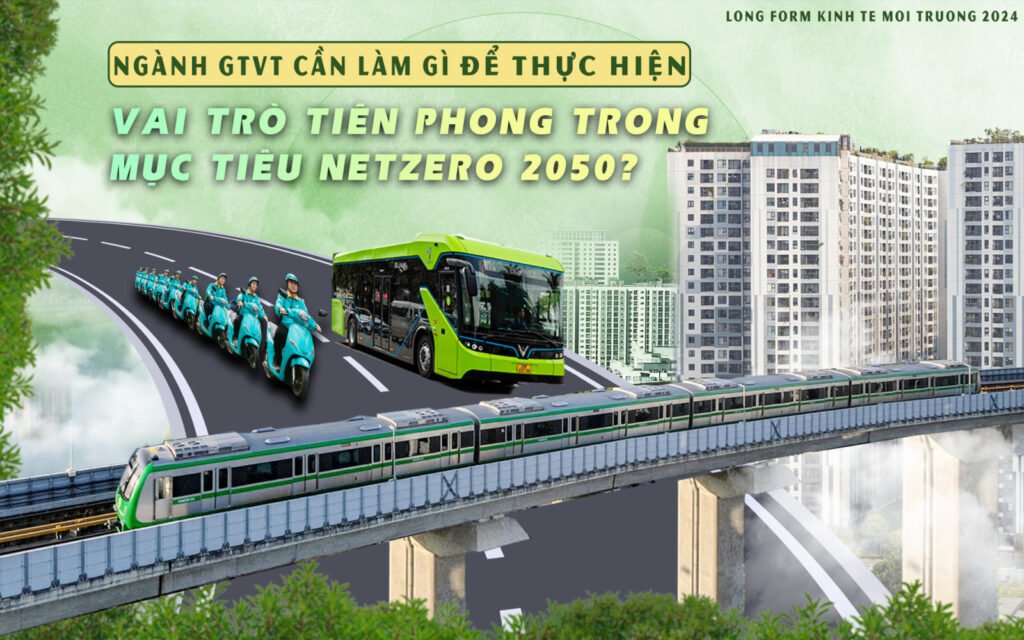

Under Decision No. 876/QĐ-TTg on the Green Energy Transition and GHG and Methane Emission Reduction Program for the Transport Sector, the Government of Vietnam has set ambitious targets. By 2040, the country will gradually limit — and eventually halt — the production, assembly, and import of fossil fuel-powered cars, motorcycles, and mopeds for domestic use. By 2050, 100% of road vehicles — including personal vehicles, public transport, and specialized vehicles — will transition to electricity or green energy. A nationwide charging and green energy infrastructure will also be completed to meet the demands of citizens and businesses. If implemented as planned, the transport sector will take the lead in reducing GHG emissions and help Vietnam meet its COP26 commitments.
Many experts, scientists, and domestic and international organizations have proposed solutions to support Vietnam’s Net Zero pledge. From an environmental research perspective, Dr. Bùi Thị Thanh Hương, Deputy Head of the Scientists’ Club at VNU and lecturer in Climate Change and Sustainability at the Faculty of Interdisciplinary Sciences, explains:
“To understand Net Zero or net-zero emissions, we must first understand its definition. Simply put, Net Zero means we do not add new emissions to the atmosphere. Emissions may still occur but must be offset by an equivalent amount absorbed from the atmosphere.”
At COP28, held in Expo City, Dubai, under the theme “Unite – Act – Deliver”, Vietnam once again strongly reaffirmed its commitment to achieving Net Zero by 2050. Meanwhile, other countries’ Net Zero targets include the US (2050), India (2070), and China and Russia (2060). Vietnam’s Net Zero 2050 roadmap focuses on specific goals:
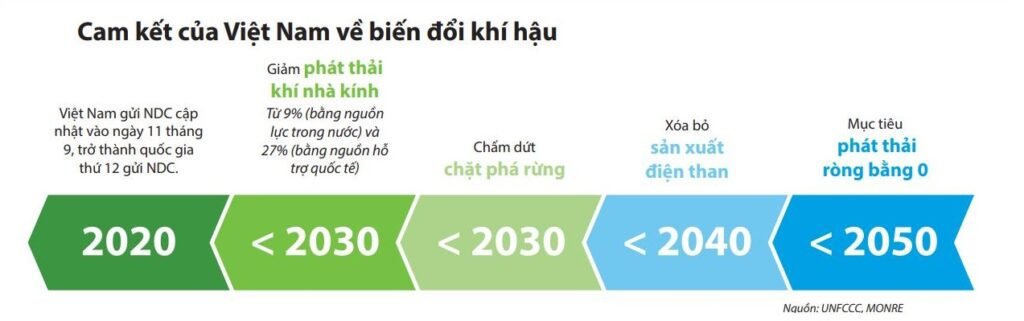
On September 11, 2020, Vietnam became the 12th country to submit its Nationally Determined Contribution (NDC), pledging to reduce GHG emissions by 9% domestically and 27% with international support by 2030. It also aims to end deforestation by 2030, phase out coal-fired power generation by 2040, and achieve net-zero carbon emissions by 2050.
Currently, total emissions from the transport sector amount to 33.2 million tons of CO₂, with 86% from road transport and 14% from rail, waterway, and aviation (Ministry of Transport, 2022). With around 30 million motorcycles on the roads and over 3 million new motorcycles manufactured annually, Vietnam ranks among the world’s largest users of two-wheel vehicles, after China and India. Emissions from this vast vehicle fleet significantly contribute to global climate change and air pollution, directly impacting public health. Greenhouse gases and particulates from transport activities are major causes of air pollution in Hanoi, one of the world’s most polluted cities, with AQI levels exceeding 150 in the last months of the year.
Like many ASEAN countries, Vietnam’s GHG emissions are roughly distributed as follows: 30% from power generation, 30% from industry, and 10% from transportation. According to a recent McKinsey report (“Roadmap to Achieving Net Zero in Vietnam”), emissions are categorized into seven sectors: agriculture, buildings, industry, energy, transportation, waste management, and land use, land-use change, and forestry (LULUCF). Of these, electricity, industry, and transportation are the three main contributors to GHG emissions.

To help the transport sector fulfill its pioneering role in achieving Net Zero by 2050, Dr. Bùi Thị Thanh Hương emphasizes that it must transition fossil-fuel vehicles and equipment to electric, biofuel, hydrogen, ammonia, or synthetic fuel alternatives. Additionally, it should develop public transport systems, such as high-speed rail by 2040, and implement an action plan for green energy transition and GHG/methane reduction in the maritime sector.
According to Dr. Hương, the sector must implement a broad range of solutions:
- Leverage technology to optimize public electric transport. Technologies like NFC/RFID can facilitate integrated payment systems, while AI can help individuals choose optimal routes and transport modes — solutions already commercialized in many countries.
- Restrict and eventually ban fossil fuel-powered motorcycles in major cities such as Hanoi, Da Nang, and Ho Chi Minh City, especially older, highly polluting vehicles. Electric bicycles and scooters should be encouraged for services like delivery and ride-hailing but regulated to prevent congestion during peak hours.
- Raise public awareness. A “no greenhouse gas emissions from vehicles” culture must be established and widely promoted. This would encourage individuals to make environmentally friendly transport choices. In many developed countries, remote work and telecommuting have been adopted to reduce transport-related pollution and congestion.
- Expand public electric transport (BEV – Battery Electric Vehicles), such as large, medium, and small electric buses, to replace fossil-fuel-based transportation. To improve efficiency, particularly with smaller buses, app-based ride-sharing and trip-matching services should be promoted to encourage shared travel and reduce reliance on private vehicles.
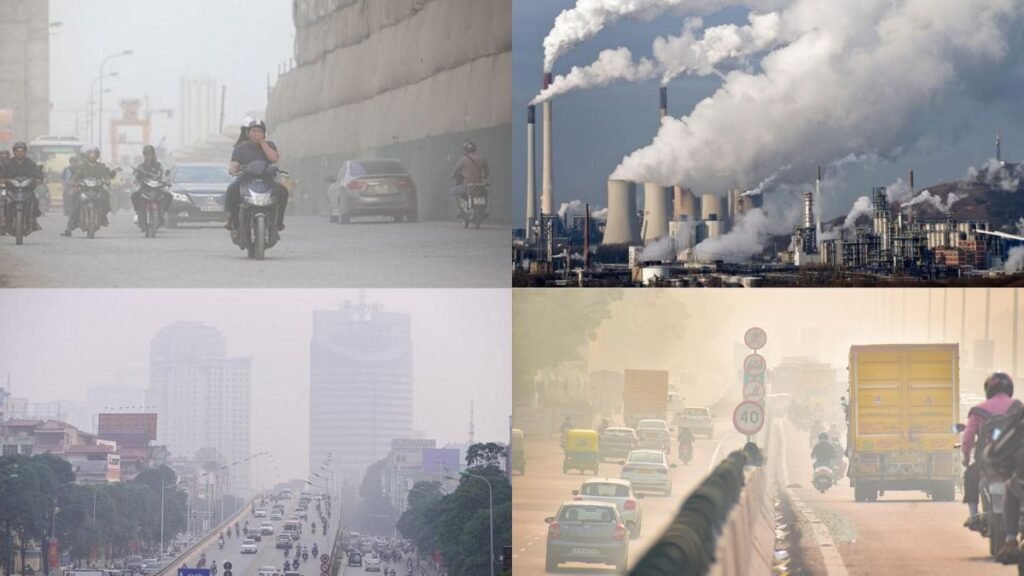

Another pressing issue is emissions from old, poorly maintained motorcycles that are still widely used. According to the 2021 National Environmental Status Report, by the end of 2021, Vietnam had over 4.5 million cars and tens of millions of motorcycles. By the end of 2022, the Vietnam Motorcycle Manufacturers Association (VAMM) reported a total of 72.7 million motorcycles. Hanoi alone has over 6 million motorcycles, nearly 3 million of which were manufactured before 2000. Ho Chi Minh City has around 7.8 million motorcycles, with 67.89% over 10 years old. Air quality indices (AQI) in urban centers often spike during peak traffic hours.
According to transportation expert Nguyen Xuan Thuy, former Director of the Transport Publishing House, outdated vehicles are among the most serious causes of environmental pollution. Reducing the number of old, high-emission vehicles is essential, but it must be done through a comprehensive, phased plan.
Assoc. Prof. Dr. Nguyen The Chinh, former Director of the Institute of Strategy and Policy on Natural Resources and Environment, emphasized that the transport sector — one of the highest emitters — must act immediately. He noted that pilot programs to phase out old motorcycles have already been implemented in Hanoi and Ho Chi Minh City, and solutions must consider three aspects: environmental, social, and economic.
- Economically, while old motorcycles are cheap and accessible, they are polluting and difficult to phase out without appropriate policies.
- Socially, many old motorcycle users are low-income individuals who rely on these vehicles for their livelihoods. Additionally, such vehicles are often unsafe.
- Environmentally, they degrade urban aesthetics, emit pollutants, and generate dust and smoke.

Dr. Chinh suggests that any policy must consider three key factors: suitability, feasibility, and enforcement. Authorities must identify how many vehicles are outdated, how many can be replaced, and establish inspection and registration fees similar to those for cars. Vehicles meeting standards could continue operation, while those that fail should be phased out.
Moreover, those affected by the policy — particularly low-income groups — should receive government support. Local authorities must provide financial assistance to ensure a fair transition. Some countries, like Germany, offer subsidies for purchasing new, greener vehicles when old ones are scrapped.
In conclusion, addressing the issue of outdated, polluting vehicles is no longer optional — it is necessary. While challenges remain, phasing out these vehicles is essential to reducing pollution and meeting Vietnam’s Net Zero commitments.
Source: kinhtemoitruong.vn