
Digitalizing waste resources toward a “material data economy” means transforming waste into data resources and using that data to manage, evaluate, and restructure the circular economy.
Editor’s Note
In the era of green and digital transformation, “waste” is no longer seen as something to discard but is increasingly viewed as a data resource. When every piece of packaging, plastic bottle, or aluminum can is traceable by a code, that material flow carries both physical and informational value.
Digitalizing waste resources toward a “material data economy” means turning waste into data resources and using that data to operate, price, and restructure the circular economy. This is considered a necessary step for a sustainable future and a greener Vietnam. Hanoi and the wider Capital Region are well-positioned to become pioneers in piloting such a model before scaling it nationwide.
However, given the current challenges in source-separated waste collection, financial limitations, and administrative constraints, digitalizing recyclable waste to turn “trash into gold” requires an integrated solution involving state management agencies and local authorities across the Capital Region.

As part of the series “Reconstructing the Environment of the Capital Region: From Strategic Planning to Actionable Solutions,” and to gain deeper insight into the trend of digitalizing recyclable waste resources toward NetZero — particularly in the Hanoi Capital Region, where growth targets are linked to environmental protection — Environmental Economics Online Magazine spoke with Dr. Bui Thi Thanh Huong, a researcher with many years of experience in circular economy models and the project leader of VNNETZERO at Vietnam National University. This project is a pilot initiative for a smart collection system integrating EPR and carbon data in Vietnam.

Dr. Bui Thi Thanh Huong, is “digitalizing waste resources” a new concept, or is it simply the application of technology in waste management?
Dr. Bui Thi Thanh Huong: The concept of “digitalizing waste resources” is not just about putting QR codes on bottles or tracking the weight of recycled materials. It’s about changing the way we define the value of used materials. When all products, packaging, and materials are part of a system that can record, quantify, trace, and identify them, “waste” is no longer something to discard but becomes a data flow with economic and environmental value.
From an academic perspective, this represents an expansion of the concept of “resources” — from tangible materials to quantifiable information. In Vietnam, digitalizing waste resources enables a shift from a management model based on propaganda and control to one based on data evidence and actual behavior. This allows for precise measurement of individual and organizational contributions to emissions reduction. In other words, digitalizing waste resources lays the foundation for a “material data economy,” where each gram of plastic or aluminum has informational value equivalent to a carbon credit unit in the near future.
In the “material data economy” model, recycling data acts as the “nervous system” of the digital circular economy. It allows for transparent tracking of material lifecycles — from production to consumption to recycling; standardizes EPR (Extended Producer Responsibility) data so companies can prove emissions reductions; and provides the basis for a recycled material credit market, similar to carbon credits.

At a deeper level, digitalizing waste resources is seen as a philosophy of regeneration — turning materials into information and allowing humans to “communicate with nature in the language of data.” It is a journey of reconciliation between economy, technology, and environmental ethics, where knowledge and materials regenerate together within the cycle of sustainable development.
“Digitalizing waste resources toward a material data economy” means transforming waste into data resources and using that data to manage, evaluate, and restructure the circular economy. In this model, each gram of waste carries informational value equivalent to a carbon credit unit, and the Hanoi Capital Region is considered the ideal location to pilot it.
How can connecting waste data with carbon data help create a “national recycled resource map”?
Dr. Bui Thi Thanh Huong: Every aluminum can and every plastic bottle contains a certain amount of avoided emissions. If recycling data is integrated with carbon data, we can create a “national recycled resource map” — a model that depicts the circulation of secondary resources. This map would help the government identify “material bottlenecks,” adjust infrastructure investments and EPR policies, and allow businesses to demonstrate actual emissions reductions and participate in the carbon credit market. Once materials are data-defined, the recycling chain becomes transparent, quantifiable, and tradable.
Could Vietnam establish a recycled materials credit market similar to carbon credits?
Dr. Bui Thi Thanh Huong: Absolutely. Once recycling data is standardized, it becomes a “new generation production factor” — equivalent to labor or capital. One kilogram of PET with a transparent data record will be more valuable than unverified material. At that point, recycling data becomes a tradable certificate: businesses can sell Recycled Material Credits to others seeking to offset their EPR responsibilities. If Vietnam acts early, it can build a dual system — carbon credits + material credits — which will drive economic incentives while ensuring environmental equity.
Would standardizing EPR data change the cost structure and competitive advantage of businesses?
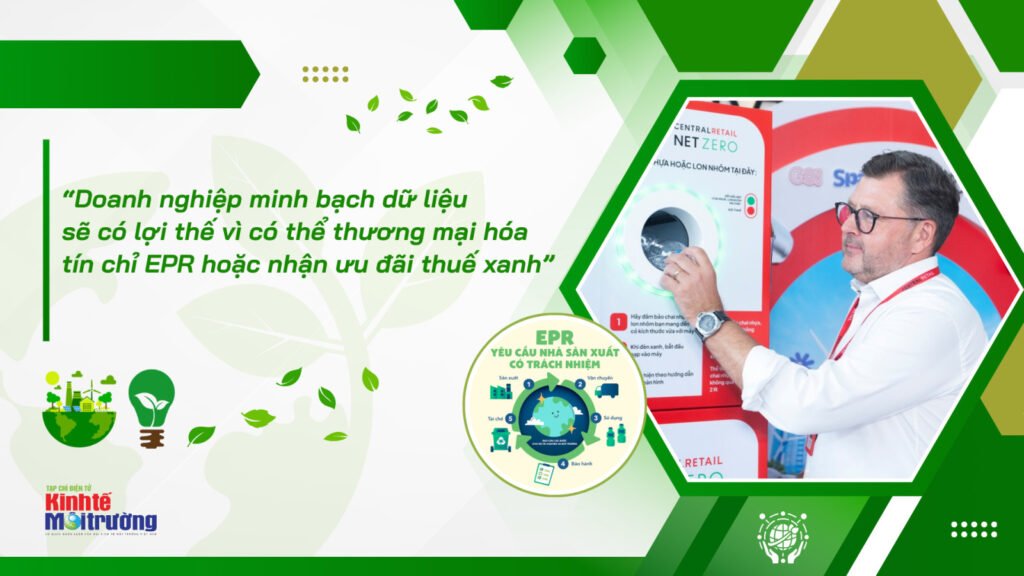
Dr. Bui Thi Thanh Huong: Definitely. Verified recycling data significantly reduces EPR compliance costs because it eliminates expensive cross-checks. Businesses with transparent data gain an advantage because they can commercialize EPR credits or receive green tax incentives. Future competitiveness will not be based on low prices but on data capabilities and environmental transparency — key factors for becoming a trusted partner in the global NetZero supply chain.

Why do you believe the “material data economy” could be a new path for cities, particularly Hanoi?
Dr. Bui Thi Thanh Huong: Because Hanoi sits at the intersection of environmental pressure and data opportunity. The city generates more than 7,000 tons of waste daily and is home to the country’s largest concentration of universities, tech companies, and research centers. This is the ideal environment to turn waste into “learning data” — where material flows and data flows run side by side.
If each ward in Hanoi could accurately track the amount of recycled plastic, aluminum, and paper and convert it into avoided emissions, we would have an urban recycled material map. This would allow the city to adjust collection infrastructure, prioritize high-emission areas, and issue local carbon credits. It’s a way for Hanoi to transition from a “consuming city” to a “regenerating city.”
What core solutions are needed for digitalizing recyclable waste resources toward a “material data economy” in the Hanoi Capital Region?
Dr. Bui Thi Thanh Huong: Digitalizing waste resources will help solve environmental pollution in Hanoi and the broader Capital Region. For this to work effectively, collaboration among state agencies and local governments is essential — as emphasized by Assoc. Prof. Dr. Truong Manh Tien, Chairman of the Vietnam Water Conservation Network (VIWACON).
Hanoi should pioneer environmental protection initiatives such as digitalizing recyclable waste resources. Some key solutions include:
- Waste auditing – the foundation of evidence-based governance
Hanoi could become the first city to implement “urban waste auditing,” similar to energy auditing. This system would measure, track, and identify all waste streams — from generation and collection to recycling — using sensors and smart stations. - Green technology – building a recycling data ecosystem
Urban waste is a “data mine” if connected with technology. Hanoi should develop an open recycling data portal linking data from collection stations (like VNNETZERO), EPR businesses, and recycling organizations. - Artificial intelligence – the “brain” of the material data economy
AI can identify, classify, and forecast urban waste flows in real time. It can detect EPR reporting fraud and, when integrated with life-cycle assessment (LCA), enable evidence-based rather than estimated waste management. - Institutional solutions – integrating legal frameworks
Current legal fragmentation between the Environmental Law, the Digital Transformation Law, and the EPR Decree creates barriers. A cross-sectoral circular should unify digital environmental governance and allow pilot projects without multi-agency approvals. - Green data culture
Citizens must become active data participants. Waste-sorting behavior recorded via apps — rewarded with points or “citizen carbon credits” — builds personal environmental profiles and fosters a culture of green data citizenship.

Digital systems can help shift from estimated to evidence-based measurement of environmental impacts — how so?
Dr. Bui Thi Thanh Huong: With real-time data, every bottle or can that is recorded represents a unit of avoided carbon emissions. When combined with life cycle assessment (LCA) models, we can accurately calculate energy savings, CO₂ reductions, and even social benefits. This marks a transformation from “qualitative reporting” to “evidence-based proof.” A system like EcoFusion illustrates this well: each user has a “personal environmental profile,” while policymakers have immediate data for planning and carbon credit allocation.
What governance mechanisms are needed to ensure transparency, data sharing, and security?
Dr. Bui Thi Thanh Huong: Environmental data must be treated as public knowledge infrastructure, not just a technical asset. Three principles must be established: transparency, sharing, and security. Transparency requires clear data ownership: who owns recycling data — citizens, businesses, or the state?
Sharing requires the creation of a national open data portal for recycling, where businesses and research institutions can access aggregated data for research, innovation, and policy monitoring.
Data security demands strong safeguards to prevent irresponsible commercialization. The ideal model is a multi-stakeholder data ecosystem: the government coordinates, businesses invest in infrastructure, universities verify data, and citizens are the primary data source.

Can we envision an open data ecosystem for recyclable waste resources?
Dr. Bui Thi Thanh Huong: Not only is it possible — it’s inevitable. Universities would serve as data verification bodies, businesses would supply sensors and platforms, and the government would issue flexible data licensing policies to allow controlled data commercialization. If done correctly, Vietnam could build a national “recycled resource database” — a knowledge base that maps material regeneration flows and enables policy, science, and the economy to operate on a shared foundation of data.
As someone who has studied environmental issues for many years, do you believe the legal fragmentation between the Environmental Law, the Digital Transformation Law, and the EPR Decree creates a policy gap?
Dr. Bui Thi Thanh Huong: Yes. This fragmentation has created a significant “policy gray zone,” and it’s precisely this gap that causes many environmental digitalization projects (such as recycled waste management, carbon credits, and EPR data) to struggle when moving beyond the pilot stage.
The Environmental Protection Law (2020) provides the basic principles — it defines EPR and requires companies to collect, recycle, or contribute financially to environmental funds. But it stops at “environmental obligations.” Meanwhile, the Digital Transformation Law (under the Ministry of Information and Communications) focuses on data infrastructure, digital identity, security, and connectivity standards. These two systems have almost no operational overlap.
When the EPR Decree (Decree 08/2022 and related circulars) goes into detail, it still lacks provisions for a “data mechanism”: who is responsible for providing traceability data, where it is stored, who owns recycled data, and whether digital platforms can participate in carbon credit verification. As a result, environmental tech companies wanting to connect waste data systems (like VNNetZero, Sparklo, or Bottol) with state management platforms face no clear entry point.
The outcome is that the three legal frameworks — environment, digitalization, and extended responsibility — operate in parallel without integration. It’s like having three roads all leading to “NetZero,” but each is managed by a different agency, with different standards, and incompatible data maps.
The Environmental Law specifies what “must be done,” the Digital Transformation Law explains what “can be done,” but the EPR Decree does not define “how to do it or who is responsible for the data.” This gap means Vietnam still lacks a “digital resource lifecycle management platform” — something Japan, South Korea, and the EU have already built to connect EPR, data, and carbon finance.
The logical next step is to issue a cross-sector circular or a flexible environmental digital policy sandbox, allowing green technology companies to pilot the integration of environmental data into the national digital infrastructure without having to “seek approval from three different ministries.”

If waste sorting is considered a civic act, how would that change the culture of environmental data?
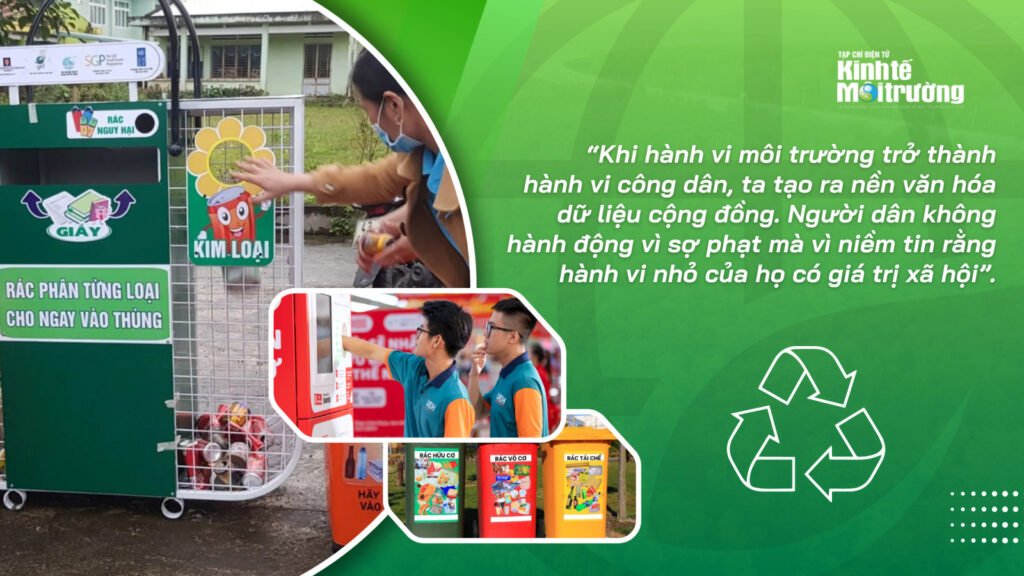
Dr. Bui Thi Thanh Huong: When environmental behavior becomes civic behavior, we create a culture of collective data. Citizens act not out of fear of penalties, but from the belief that their small actions have social value. Each time they scan a code to submit waste, they are “writing a positive data record” into the story of development. This culture helps form a new identity — one where data becomes a symbol of ethics and urban civility.
Building public trust in the data system is a prerequisite. What does Vietnam need to achieve this?
Dr. Bui Thi Thanh Huong: Three things: transparency, feedback, and validation. Transparency ensures that people understand how data is used. Feedback shows them results — for example, “our neighborhood reduced CO₂ by 1 ton.” And validation comes from third parties — universities and research institutions — to guarantee the data isn’t manipulated. When technology is tied to scientific transparency, we create environmental data democracy, where trust becomes the energy that powers the system.
How should we interpret the phrase “waste doesn’t disappear, it just changes form” in the context of the NetZero journey?
Dr. Bui Thi Thanh Huong: It’s a philosophy of regeneration. Waste reflects our development model — the shadow of consumption. Through digitalization, we turn materials into data, enabling humanity to communicate with nature in a digital language. Waste ceases to be a “sin” and instead becomes a reminder of our limits and responsibilities. At its core, digitalizing waste resources is a reconciliation between humanity and Earth — where knowledge, ethics, and matter re-enter the cycle of life together.
The Political Report of the 18th Hanoi Party Congress for the 2025–2030 term contains several environmental “highlights.” Could you share your thoughts on this?
Dr. Bui Thi Thanh Huong: The Political Report of the 17th Hanoi Party Executive Committee for the 2025–2030 term emphasizes that Hanoi’s development approach combines rapid and sustainable economic growth with green transformation, digital transformation, and a circular economy. The city aims to balance socio-economic development with environmental protection and effective climate adaptation, improving residents’ quality of life.
This is Hanoi’s consistent approach to environmental issues. Regarding waste, the city plans to shift toward modern waste-to-energy technology to replace landfilling while strengthening source separation. The goal is comprehensive waste treatment, minimal environmental impact, and the development of a circular economy model.
For plastic waste, Assoc. Prof. Dr. Luu Duc Hai — President of the Vietnam Environmental Economics Association — has stressed the need for organized collection, classification, and reuse of plastic waste under a circular economy model. He also emphasized the importance of applying technical solutions, economic instruments (such as environmental taxes on plastic products and fines for illegal disposal), and public education campaigns on plastic pollution.
From Hanoi’s policy direction to expert recommendations, I believe building an environmental protection culture among citizens is essential. It is the key to controlling and ultimately solving pollution problems, including waste. This reflects both the core values of a civilized and elegant Hanoi and is a prerequisite for building a cultured, modern capital.
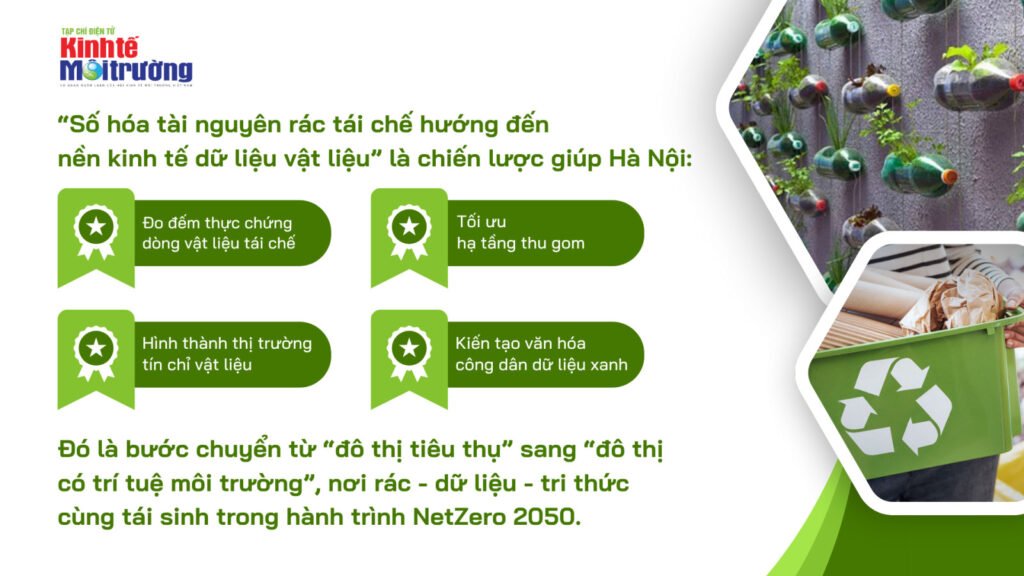
“Digitalizing recyclable waste resources toward a material data economy” is not just a technological innovation — it is a restructuring of philosophy, institutions, and behavior in urban resource management. Once waste is transformed into data, it is no longer an unwanted byproduct but a measurable, identifiable, and tradable information asset. This data becomes the “nervous system” of the digital circular economy, where every plastic bottle, aluminum can, and piece of paper contributes to the value chain of emissions reduction and innovation.

For the Capital Region — and Hanoi in particular — this is not only an environmental challenge but also an opportunity to redefine urban governance capacity in the data era. When the city knows exactly where waste goes, how it is recycled, and how much emissions are reduced, every policy — from EPR to local carbon credits — can be based on evidence rather than estimates.
From waste auditing and green technology infrastructure to artificial intelligence applications and cross-sector legal frameworks, Hanoi can become Vietnam’s first policy laboratory for the “material data economy.” In this model, waste, data, and knowledge no longer exist in isolation — they operate together in a new cycle: the cycle of environmental intelligence, where technology and a green civic culture power the journey toward NetZero 2050.
Source: kinhtemoitruong.vn