
Japan is renowned for having one of the most rigorous and efficient waste sorting systems in the world. In Japan, waste separation is not only a civic duty—it has become part of daily life and social culture.
Dr. Bui Thi Thanh Huong, lecturer and sustainable education expert at the Department of Climate Change and Sustainability Science, VNU University of Interdisciplinary Sciences and Arts, shared insights about Japan’s waste sorting model and the lessons it offers for Vietnam.
Non-compliance Gets a “Violation Label”
Reporter: As someone who has researched waste management in Vietnam and other countries, when did Japan begin developing its waste sorting habits, and what are the legal and social foundations behind it?
Dr. Huong: Japan began to institutionalize waste sorting in the 1970s with the Waste Management and Public Cleansing Law (Law No. 137 of 1970). This law clearly defines environmental protection goals through reduction, separation, collection, recycling, and proper disposal. It became the foundation for all subsequent local waste sorting regulations.

In the 1990s, the “3R” movement—Reduce, Reuse, Recycle—was strengthened through the Container and Packaging Recycling Law (enacted in 1995, partially enforced in 1997, expanded in 2000). The law specifies roles: local governments handle sorted collection, businesses are responsible for recycling, and citizens separate waste at the source. The system is operated by JCPRA, a government-designated organization.
Since 2000, Japan has implemented the Basic Act for Establishing a Sound Material-Cycle Society, which requires the government to create a master plan for a circular economy and apply the 3R policies nationwide. This is the highest-level legal framework connecting sector-specific recycling laws (for appliances, food, construction, etc.).
On the social side, municipalities are empowered to issue waste sorting manuals, collection calendars (gomi calendars), and regulations requiring transparent or designated garbage bags. Those who fail to comply receive a violation sticker, and their waste is left uncollected. This “public shaming with corrective guidance” mechanism helps establish lasting social norms and encourages proper behavior naturally.
Reporter: Could you describe the waste sorting process in Japan—what types of waste exist, and how are they collected?
Dr. Huong: Each local government has its own classification system, so the number of waste categories varies. However, most use 4–6 main groups:
- Bulky waste (sodai gomi): collected on specific days; residents must buy a fee sticker or tag.
- Burnable waste: food scraps, dirty paper, cloth, small wooden items, etc.
- Non-burnable waste: small metals, ceramics, broken glass, etc.
- Recyclables: PET bottles, metal cans, glass bottles, paper, cardboard, plastic packaging.
For instance, Yokohama provides detailed guidance: burnable waste must go into transparent bags; PET bottles must be washed and flattened; dry batteries are separated. Collection schedules are published daily or weekly with illustrated “right/wrong” examples.
In Tokyo’s 23 wards, waste is typically divided into five categories, with online collection calendars. Bulky waste must have a sticker and be placed out only at the designated time. Some areas use a “pay-as-you-throw” system requiring residents to buy official garbage bags; others, like Tokyo, don’t charge for bags but mandate clear or semi-transparent ones—black bags may be rejected.
Reporter: Beyond the system, how are Japanese citizens educated and encouraged to sort waste properly?
Dr. Huong: Japan uses a highly integrated set of tools—illustrated sorting guides, mobile apps with reminders, color-coded bags, and transparent penalty rules.
Crucially, they have a feedback mechanism: if a bag violates the rules, collectors leave it behind with a warning sticker, requiring residents to re-sort it. This “behavioral education” approach is highly effective—it fosters voluntary compliance without harsh fines.
Lessons for Developing Countries
Reporter: What key lessons can developing countries like Vietnam learn from Japan’s system?
Dr. Huong: The success rests on three synchronized pillars:
- Economic and Data Transparency: Incentives such as pay-as-you-throw bags, digital “green point wallets,” and public dashboards.
- Law and Policy: Clear role division among government, local authorities, businesses, and citizens.
- Infrastructure and Logistics: Coordinated systems for collection points, bins, routes, treatment, and recycling facilities.
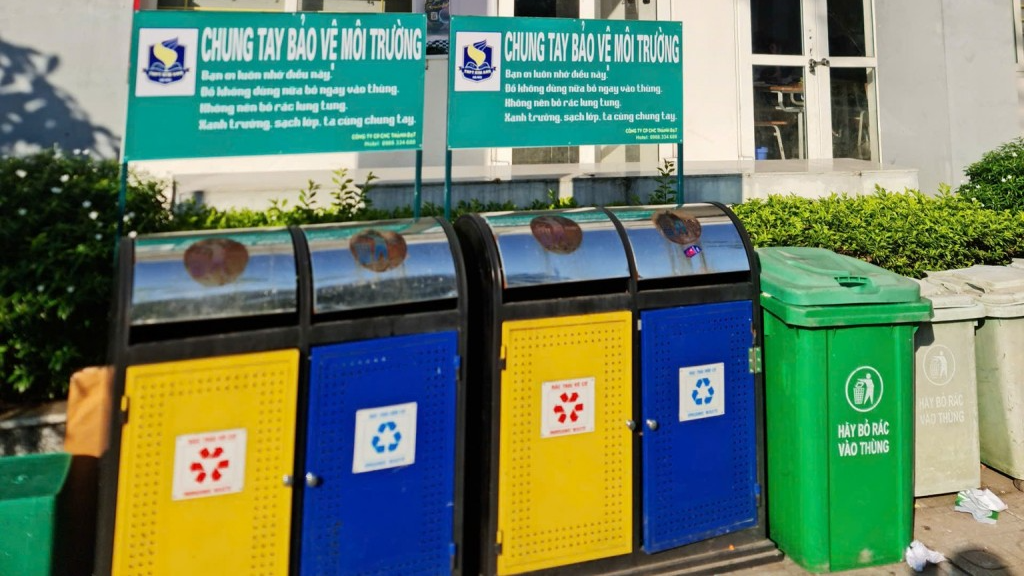
Japan succeeded because it designed behavior, not just slogans. Simple “nudges” like clear bags, warning stickers, or reminder apps have tremendous psychological impact.
Especially, companies play a central role through the Extended Producer Responsibility (EPR) system—producers must fund, collect, recycle, and report results publicly. Vietnam already has this legal foundation under the Environmental Protection Law 2020, Decree 08/2022/ND-CP, and Decree 05/2025/ND-CP—the key is stronger local implementation.
Reporter: What is the most crucial factor for Vietnam to successfully adopt Japan’s model?
Dr. Huong: I believe the breakthrough lies in data integration and end-of-line infrastructure. A complete chain—from bins, sorting bags, collection calendars, transfer stations to recycling facilities—is essential. Without the “end-point,” sorting at source collapses once waste hits the collection truck.
Equally important is real-time data transparency: maps of collection points, electronic scales, and public EPR dashboards. When people can see where their waste goes, they sort better. Japan does this excellently through the “gomi calendar/app” system.
For businesses, EPR must be enforced with clear financial or recycling responsibilities and public reporting per sector—similar to the CPRL model.
Reporter: Should Vietnam prioritize law, education, or infrastructure first?
Dr. Huong: All three are interconnected, but implementation should start with infrastructure and economic mechanisms:
- Standardize waste categories (e.g., five groups) with unified colors, bins, and bags.
- Pilot transparent bags in major cities.
- Apply pay-as-you-throw or digital reward systems to encourage correct behavior.
Legal framework: Utilize the Environmental Protection Law 2020, Decree 08/2022, and Decree 05/2025 to issue local regulations for source separation, and assign measurable KPIs to district governments and EPR enterprises.
Education and communication: Replace slogans with illustrated manuals, digital collection calendars, and corrective mechanisms (violation stickers, non-collection, clear guidance).
This approach—firm but instructive—is why Japanese citizens comply so naturally: they are guided, not merely warned.
Reporter: What overarching message would you give Vietnam in this journey?
Dr. Huong: Japan succeeded because it treats waste sorting as a data-driven public service, not a campaign.
When Vietnam strengthens EPR enforcement, requiring producers to take full lifecycle responsibility, invests in downstream infrastructure (sorting, compacting, recycling, material reintegration), and adopts “light but firm” behavioral enforcement (violation stickers, digital calendars, transparent bags), the system will self-sustain.
People will sort waste correctly not because they are forced to, but because it is convenient, transparent, and socially recognized.
To foster sustainable green behavior, Vietnam must transform waste sorting into a digital public service system, not a movement; standardize collection infrastructure; digitize local collection schedules; and integrate EPR data codes for companies to ensure transparency of material and financial flows.
Once “waste has an identity” and “citizens have easy tools,” proper behavior becomes a natural habit in an intelligent society—without slogans or loudspeakers. Only then will digital resource management—from policy to culture—be truly complete and profound.
Thank you very much
| About Dr. Bui Thi Thanh Huong Dr. Bui Thi Thanh Huong is a lecturer at the Department of Climate Change and Sustainability Science, University of Interdisciplinary Sciences and Arts, Vietnam National University, Hanoi. She serves as the Southeast Asia Regional Coordinator of the International Society of Waste, Air, and Water Management (ISWMAW), which operates in over 50 countries. She is also the founder and CEO of VNU Greentech Spin-off JSC, and a policy consultant for ministries and international organizations such as UNDP, UNESCO, and WWF in green development and circular waste education. Additionally, Dr. Huong mentors student start-up teams with award-winning projects on smart waste recycling and community education toward a cleaner, zero-waste future. |
Nguyễn Dũng