
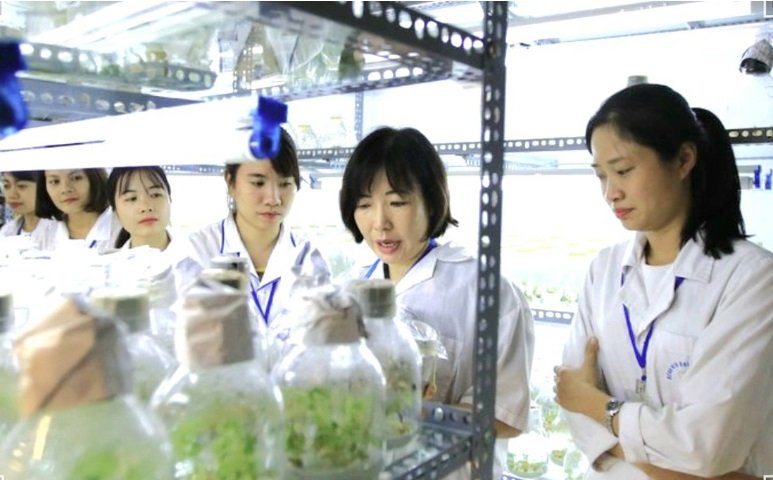
Although women account for nearly 46% of Vietnam’s scientific and technological research workforce, fewer than 5% of research projects led by women have been successfully commercialized. This striking imbalance suggests that a vast reservoir of intellectual capital generated by women scientists remains trapped at the threshold of the marketplace. Removing these barriers has become an urgent priority to prevent the continued waste of scientific talent and to ensure that research delivers tangible benefits to society.
Research Destined for the Drawer?
At a small manufacturing facility in Hanoi, packages of VN NETZERO Perilla Tea—a product developed under the GREENTECH ecosystem by a university spin-off enterprise originating from Vietnam National University—are being prepared for commercial distribution. The product embodies advanced scientific research and promotes a sustainable lifestyle. However, its journey from laboratory innovation to consumers has proven far more difficult than anticipated.
Dr. Bui Thi Thanh Huong, who oversees the project, explained that although the product has entered Vietnam’s regulatory sandbox mechanism, numerous administrative obstacles remain. The most significant challenge is the high cost of services and cumbersome procedures associated with the National Science Information Portal, where researchers must access patent databases to independently verify the novelty of their inventions before filing patent applications. Navigating this maze of procedures and expenses places an enormous burden on scientists whose expertise lies primarily in research rather than administration.

Similar stories are common among women researchers working on biological products for organic agriculture, including microbial fertilizers and botanical pesticides. These research areas attract many women scientists because they require meticulous experimentation and long-term perseverance. However, once these products enter the market, they immediately encounter skepticism from both consumers and major distributors, who have long relied on inexpensive chemical alternatives. As a result, sophisticated scientific innovations are often perceived as simple homemade products, making it difficult to price them according to their true technological value.
Moreover, university spin-off enterprises typically possess limited distribution networks and insufficient commercial expertise. Consequently, many products circulate only within conferences, exhibitions, and institutional showcases rather than reaching mainstream markets.
These real-world experiences expose a long-standing systemic contradiction. Recent quantitative surveys conducted by the Vietnam Association of Women Intellectuals reveal a concerning reality: although women represent nearly 46% of Vietnam’s science and technology workforce, fewer than 5% of research projects and inventions led by women are successfully transferred to the market. Such a significant disparity indicates that the intellectual contributions of women scientists are being blocked at the final stage of commercialization due to the absence of a well-functioning innovation ecosystem at the implementation level.

What Lies at the Root of the Problem?
These challenges and contradictions surrounding the commercialization of scientific research became the central topic of discussion at a recent scientific workshop organized by the Vietnam Association of Women Intellectuals. Rather than presenting routine achievements, participants openly examined why research led by women scientists faces such formidable barriers in reaching the marketplace. Many speakers emphasized that the problem extends far beyond individual capabilities; instead, it reflects structural shortcomings in governance mechanisms and the absence of effective intermediary organizations.
During the workshop, Associate Professor Dr. Bui Thi An, Director of the Institute of Natural Resources, Environment and Community Development, highlighted fundamental weaknesses in Vietnam’s research funding system. Ideally, research projects should originate from genuine market demand. In practice, however, projects are often selected simply because funding is available, leading to fragmented budgets and, in some cases, allocations influenced by personal relationships. Such practices disperse financial resources across too many projects, leaving insufficient investment for prototype development and pilot-scale production. Without adequate pilot testing, technologies that receive excellent evaluations during official project assessments remain unprepared for commercialization.

Beyond funding issues, workshop participants also expressed concern over the lack of transparent incentive mechanisms, which undermines the motivation of young researchers. Associate Professor Dr. Le Thi Thuy, Standing Committee Member and Head of the Science and Technology Committee of the Vietnam Association of Women Intellectuals, pointed to persistent inequities in the commercialization of publicly funded technologies, particularly environmental technologies. She noted that researchers often receive no fair share of licensing revenues despite making substantial intellectual contributions.
In some cases, even public recognition of technological achievements has been unfair. Technologies developed by institutes under the Vietnam Academy of Science and Technology have been formally transferred through official agreements, yet media reports have occasionally credited recipient organizations or other parties instead of acknowledging the original developers. When researchers invest years overcoming the most challenging stages of technological development but receive neither appropriate financial compensation nor legal protection, many talented young scientists naturally become discouraged from pursuing long-term research careers.
From the perspective of innovation intermediaries, Ms. Le Thi Khanh Van, former Deputy Director General of the National Agency for Science and Technology Information under the Ministry of Science and Technology, offered equally practical insights. She argued that organizations responsible for supporting technology transfer have yet to fulfill their role as effective “midwives” for women scientists. Vietnam still lacks independent technology valuation agencies and sufficiently strong supply-demand matching networks. In the absence of transparent incentive mechanisms and efficient intermediary institutions, women researchers are forced to approach businesses individually, manage legal procedures themselves, and shoulder commercial risks alone. Under such circumstances, many ultimately choose the safest option: placing their completed research back into the drawer once the project has been formally accepted.

Turning Policy into a Functional Innovation Ecosystem
The recently issued Resolution No. 57-NQ/TW and Resolution No. 20-NQ/TW provide a timely response to many of the structural challenges identified during the workshop. These strategic policy documents represent an important shift from an administration-oriented management approach toward one that emphasizes measurable outcomes, with businesses and markets placed at the center of the national innovation system.
Perhaps the most significant breakthrough for scientists—including women scientists—is the establishment of a legal framework that accepts reasonable research risks while encouraging the creation of university and research institute spin-off enterprises. Now that the policy direction has been established, the remaining challenge lies in implementation. Concrete actions are needed to transform these strategic orientations into practical support mechanisms capable of bringing the intellectual achievements of women scientists out of the laboratory and into society.
According to experts, three coordinated actions are essential for translating these major policy initiatives into reality.
First, research governance must move away from a system based on administrative allocation of research topics toward one in which the government commissions research to address real societal and industrial needs. During the early commercialization stage, the government should also provide market support and risk-sharing mechanisms for science and technology products, thereby reducing uncertainty for businesses. Hanoi’s recent initiatives—including resolutions on accepting research risks, piloting regulatory sandbox mechanisms, establishing talent attraction funds, and supporting innovation investment—provide practical examples that could be expanded nationwide.
Second, specialized Market Task Forces should be established to strengthen connections between scientific supply and market demand. Building upon proposals from Dr. Thanh Huong and analyses by Ms. Khanh Van, organizations such as the Vietnam Association of Women Intellectuals could establish dedicated teams responsible for identifying actual market needs, securing purchase commitments from businesses and investors in advance, and only then funding corresponding research projects. This market-driven approach—working backward from demand to laboratory research—would greatly improve the likelihood of successful commercialization. At the same time, the National Science Information Portal should integrate its databases more effectively while reducing service fees, enabling researchers to verify patent novelty more efficiently and at lower cost.
Third, if policy is to address gender-specific barriers effectively, women must be better represented in scientific leadership positions and policy-making bodies. As Associate Professor Dr. Bui Thi An emphasized during the workshop, if women scientists are expected to bring their research successfully to market, they must also participate fully in shaping science and technology policies themselves.
Ultimately, enabling scientific research to flow from the laboratory to the marketplace requires a fundamental transformation in governance mechanisms and policy transparency. Only when implementation bottlenecks are removed will the intellectual potential of women scientists be fully unleashed, allowing their innovations to become a powerful driver of national development.
Source: phunuvietnam.vn